

The Four Winds
Oracle Card. Imbas Dispatch #43

Hello Shining Ones,
I’m beginning this week carried by the gusts of the four winds with another oracle share from Celtic Dream Oracle: Ancient Symbols to Guide Your Modern Life.
Bringing this oracle deck to life is a core tenet of my own spiritual practice. Even if it never came into form, into matter, physical cards in hand - it still matters to me. It is a slower than I’d like process, which is always a good lesson for my fizzy energy. I never know what card will emerge next, all I can do is gaze inwards to the abyss and wait for it to come. It often shapeshifts at first so hours upon hours upon hours of creation can seem ‘lost’. And yet, it offers sacred space to be in deep, relational conversation with - and to trust - in the Otherworld, in the wisdom of our ancestors.
So here we are, another oracle kindled, and I’m so grateful for all of your loving and encouraging responses to these cards.
Four Winds
Keywords:
Winds, Direction, Inner-Compass
Suit:
Colours
Symbol:
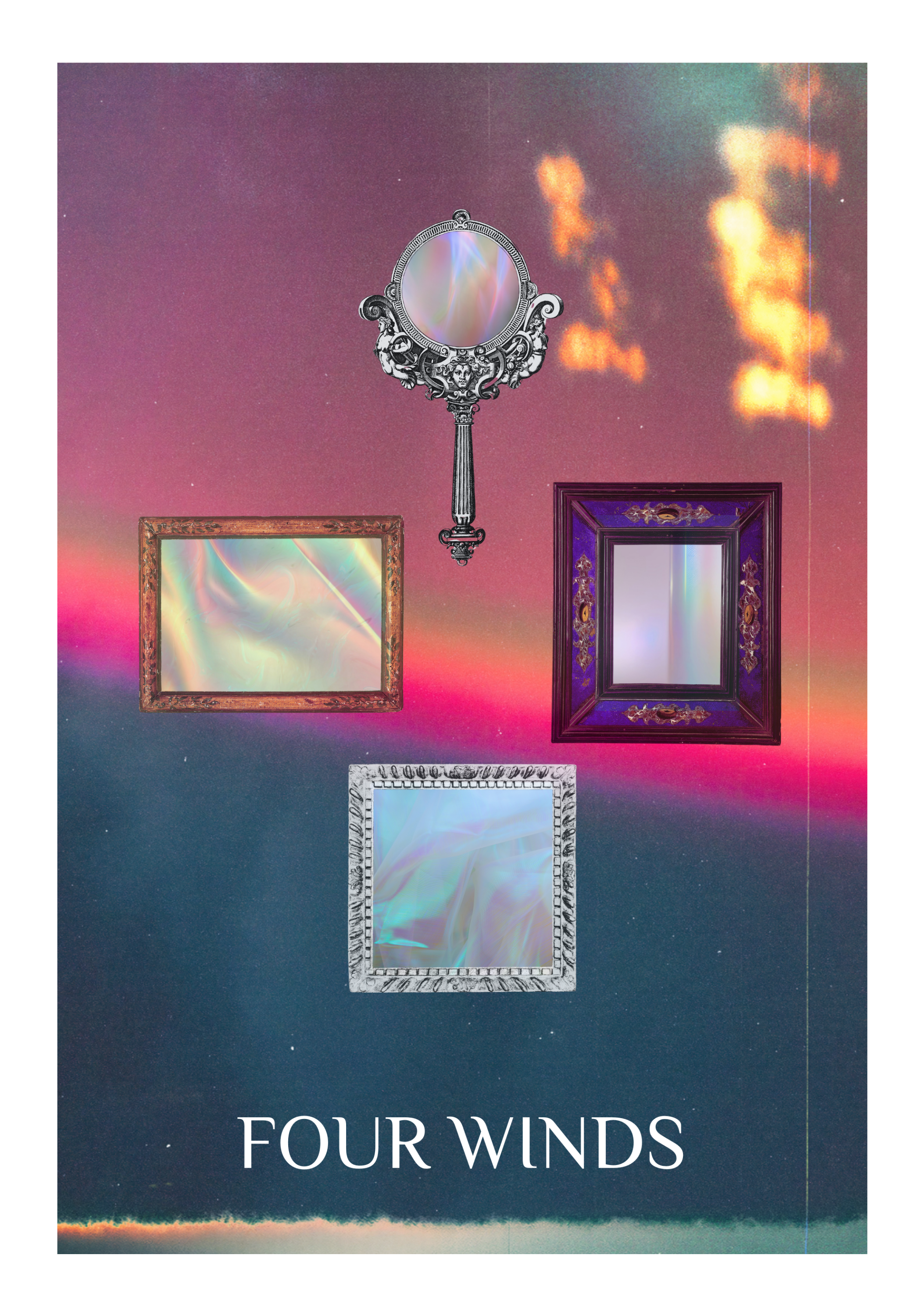
Four mirrors in four directions - east, south, west, north - in purple, white, brown, and black, mirror back to us the energy of where we find ourselves.
Lore:
In Irish tradition, the four directions - east, south, west, north - hold specific energies, and as Celtic scholar Sharon Paice MacLeod has illuminated, the four great winds that carry these energies may each have a specific colour. Directions themselves in the Irish language are more nuanced than in English. Rather than fixed points, they express your relationship to place, where you are and where you’re moving with intention. All of this combined can offer us symbolic direction for our own inner-work, our own inner-compass.
Purple Wind of the East
To the east, we have the energy of bláth or prosperity. Bláth means to flower or blossom. This, as the sources tell us, holds an energy of nobility, wonders, splendour, wealth, many arts, beehives, sumptuous fabrics, good custom, and hospitality. The colour purple, corcair (corcra in modern Irish), is the colour of lichen that grows on trees, rocks and soil, which was used as a dye in Old Ireland, and provided pigment for the 1,200-year-old illuminated manuscript, the ‘Book of Kells’. Purple is a colour associated with the great mysteries. It symbolises the integration of the opposites, the fiery red of the sun with the cool blue of the moon. In Irish folklore, a purple blaze in the fire is a sign that rain is coming. Rain is a symbol of abundance, a shower of blessings.
White Wind of the South
To the south, we have the energy of séis or music. Séis means a musical art or melody. This direction holds the energy of waterfalls, fairs, musicianship, melody, learning, knowledge, fidchell-playing (fidchell means ‘wood intelligence’, an ancient Irish form of chess), and poetical art. The colour white, bán, also find (modern Irish: finn), meaning ‘fair’, ‘light-hued’, ‘blessed’, and gel (modern Irish: geal), meaning ‘bright’, ‘shining’, is often the colour of otherworldly beings. White is the colour of milk from the breast of the mother, and of the white cow of plenty who emerges from the Otherworld. It is the salt that gives life its sting and its flavour, a healer of wounds. It is the albedo in alchemy, the dawn of a new consciousness, a soul’s melody in composition.
Brown Wind of the West
To the west, we have the energy of fis or learning. Fis means to seek knowledge. This direction holds the energy of foundations, stories, histories, chronicles, counsels, eloquence, teaching, alliance, and beauty. The colour dun (donn in modern Irish) is brown but with tawny yellow, chestnut red, and greyish hues. It symbolises fecundity, fur, and feathers. Many animals on this land have a dun quality, and so, here we find a connection to our more-than-human kin. The first poem uttered in Ireland, the ‘Song of Amergin’, is an invocation to the soul that shines in all living creatures, including the land herself, to a soul made of fecundity, fur, and feathers. Dun is the regenerative cycle of soil, seeds, and spoil. It is in these cycles where life’s greatest learning is found.
Black Wind of the North
To the north, we have the energy of cath or battle. Cath means battle or fight. This direction holds the energy of our inner-rough places, our pride, contentions, conflicts, hardihood, strifes, assaults, and captures. The colour black, dub (dubh in modern Irish), is the colour of eyelashes, of Badb the crow goddess of war, of the void, chaos, fear, and melancholy. It is the first stage in the great work of alchemy, the dark night of the soul that leads us in blind and sorrowful surrender to our inner treasure. It is a point of entry to the Otherworld; many of the filí, the poet-seers, were blind in one eye, and Bardic poetry was composed in the dark until the 18th century. It is the black hole, the womb, the new moon incubating the not yet manifest. All possibilities - our gold - exist in dub.
When this card appears:
What inner direction do you find yourself in? Forget about where you actually live - direction is relative. I am in the north of Dublin but also the east of Ireland; what matters is the symbolic landscape. These directions are a metaphor for the location of your soul at this time.
The Four Winds oracle asks you to reflect on where you find yourself standing. Listen to the wind of this direction, see its colour blow in the air. What would it have you know?
Invocation:
Close your eyes. Place a hand on your heart, as your inner compass. Invoke:
‘I am a listener of winds,
Winds that stir my inner-compass,
These winds, they orient me,
To where I know I must go.’

Sin é for now. 🌬️
Croí isteach,
Jen x
Sources:
Celtic Cosmology and the Otherworld: Mythic Origins, Sovereignty and Liminality by Sharon Paice MacLeod.
The Saltair Na Rann: A Collection Of Early Middle Irish Poems by Whitley Stokes.
The Settling of the Manor of Tara (Suidigud Tellaig Temra), translated by Richard Irvine Best.
Ooo. I love the image you depicted for the north!
Ah Jen, you write so beautifully. Each paragraph an inspirational gift. Thank you