

Hello Shining Ones,
Here we are with Étaín (“Ay-teen”, also Éadaoin or Aideen), the mythic ancestor we will spend time with this month. She is a princess, a queen, a fairywoman, a sovereignty goddess, a shapeshifter, and for me personally, she is a symbol of soul. Hers is a story of psyche, of the soul’s journey through lifetimes. Like Psyche in Greek mythology, we meet Étaín in her first life when she is young, beautiful and full of ‘maidenly majesty’.
Before we begin, a gentle reminder that on Thursday, 23rd October, I will host a Fairytale Céilí, our myth and movement gathering where we will explore the tale that Étaín is most well-known for, Tochmarc Étaíne or in English, ‘The Wooing of Étaín’. You’ll get to experience her story and metabolise it through your body so she can work with your soma and psyche, your corp agus anam, your body and soul, and reveal herself to you.
Lost Manuscript
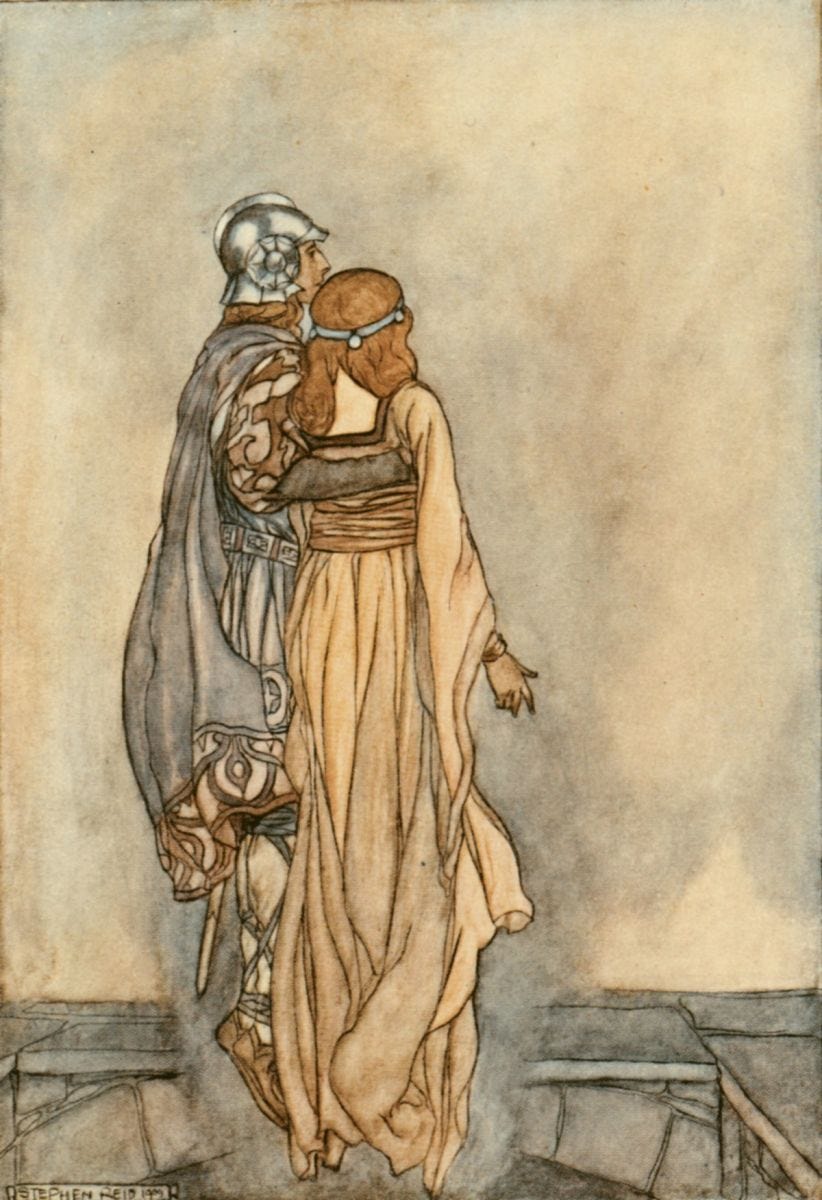
The myth of The Wooing of Étaín was only reclaimed in its fullness less than 100 years ago, in 1937. It had been partly preserved in the 12th century Lebor na hUidre, the ‘Book of the Dun Cow’. Then uncovered by chance hidden in Leabhar Buidhe Leacáin, the ‘Yellow Book of Lecan’, a 14th century manuscript. Its language dates back to the 8th century so it is one of the oldest preserved stories we have. There is reference in the Yellow Book of Lecan to a lost manuscript Cín Dromma Snechtai, the ‘Book of Dromma Snechta’. It has been suggested that an older version of the tale may be contained within this. And of course, our mythology first fell from the tongues of our ancestors, not from leaves of vellum, so who knows how long Étaín danced in mouths before she was ever recorded in the written word.
Horse Symbolism
There’s a curiosity around Étaín that is not explained in The Wooing of Étaín and this is her epithet, Echraide, which means ‘of the horses’ or ‘horse-rider’. From this, our mythic imagination can wander to other Celtic goddesses associated with horses like the great queen, Rhiannon in Welsh mythology and her enchanted white horse, to the goddess Epona from the Gaulish epos, which means ‘horse’, to the Irish goddess, Macha who as John Moriarty says, ‘The most beautiful of women is Macha: she opens her thighs and you see a mare’s mouth.’
As a symbol, the horse held immense importance for our ancestors, and therefore for us inherited in our unconscious. The horse is regal, it is noble, it is grace, and it is also wild power. As we see in another mythical horse-rider, Niamh Cinn-Óir, ‘Niamh of the Golden Hair’, she rides from Tír na nÓg, from the Otherworld to Ireland across the waves on her white horse, who also transports her mortal husband, Óisín. The white horse is a psychopomp transporting the soul between mortal and otherworldly realms. In Irish folklore, the fairies themselves often come out of the fairy mounds riding a procession, a fairy host of white horses.
In Greek mythology, Poseidon is the father of horses, we see a similar motif in Irish mythology, with the god of the sea, Manannán Mac Lir who gallops across the waves in his chariot drawn by his horse, Énbarr meaning ‘the one or unrivalled mane’. The white foam on the waves are the horses of Manannán.